

5 Cosmetic Dentistry Breakthroughs in 2026: The Future of Your Smile at Tribeca Smiles
Key Takeaways
- 2026 cosmetic dentistry breakthroughs include enamel regeneration gels, AI smile design, and bio-smart materials that respond to your mouth's chemistry.
- Cone Beam Computed Tomography (CBCT) provides precise 3D, sub-millimeter imaging of bone and soft tissues, offering higher accuracy for treatment planning than traditional 2D X-rays.
- Same-day dentistry is now standard—no more messy impressions or multiple appointments for crowns and veneers.
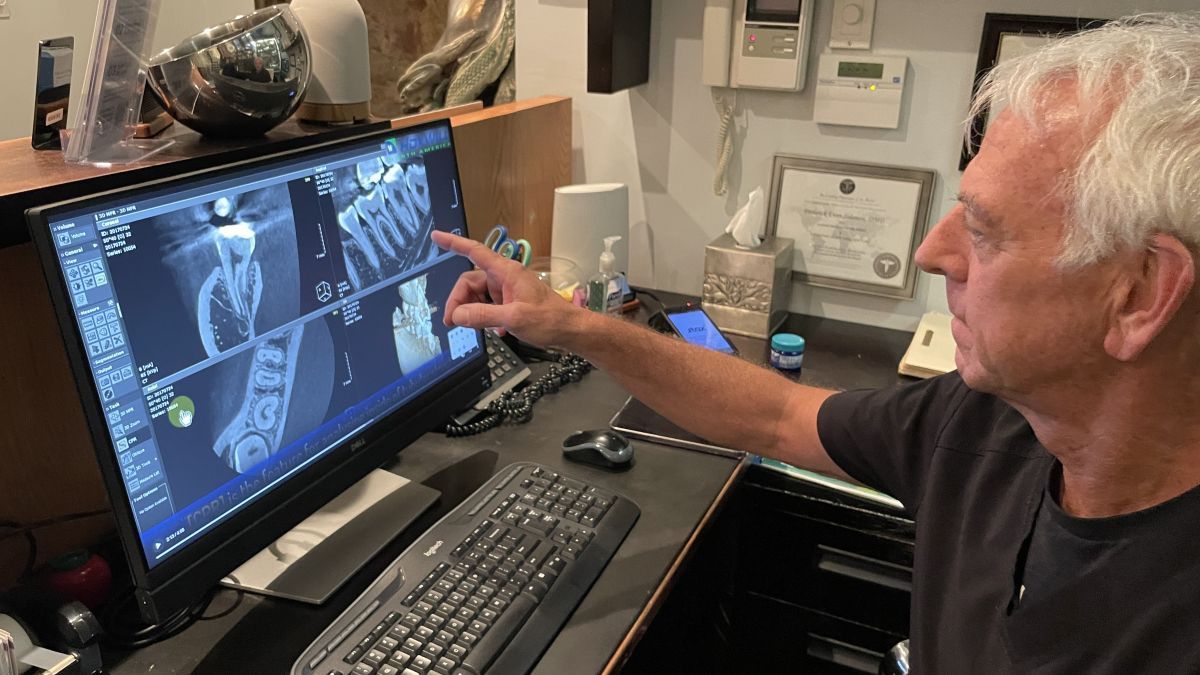
The year 2026 has brought changes to cosmetic dentistry that would have seemed far-fetched even five years ago. We're talking about gels that regrow your enamel, AI that designs your smile based on how your face moves, and materials that release protective minerals when your mouth gets too acidic.
These 2026 cosmetic dentistry breakthroughs represent a fundamental shift—from fixing teeth to helping them heal themselves.
What does this mean if you’re considering cosmetic dental work this year? It means less drilling, faster appointments, more predictable results, and restorations that work with your biology instead of just sitting in your mouth. Let's break down the five major advances shaping cosmetic dentistry right now.
Enamel Regeneration: Gels That Regrow Your Tooth Structure
For decades, the rule was simple: once enamel is gone, its gone. Lost to grinding, acid erosion, or decay—the only option was covering it with something synthetic.
That changed in late 2025 and throughout 2026 with protein-based regeneration gels that can rebuild enamel from the inside out.
How does this work? The gels contain proteins that mimic amelogenin—the same protein your body used to form enamel when you were an infant. When applied to damaged or thinned enamel, these proteins create a scaffold that captures calcium and phosphate ions from your saliva.
These minerals then organize into hydroxyapatite crystals that align with your existing tooth structure.
What enamel regeneration treats:
- White spot lesions (those chalky marks left after braces)
- Early demineralization before it becomes a cavity
- Thinning enamel that makes teeth look yellow
- Dentin hypersensitivity from exposed tooth surfaces
The cosmetic implications are significant. Thin enamel gives teeth a dull, yellowish appearance because the darker dentin shows through. Rebuilding enamel thickness restores natural translucency and brightness without bleaching.
For patients getting veneers or otherrestorative dentistry work, a regenerated enamel layer also improves bonding strength.
| Feature | Traditional Fluoride | Regenerative Enamel Gel |
|---|---|---|
| How it works | Forms fluorapatite coating | Regrows organized enamel crystals |
| Structural repair | Surface hardening only | Rebuilds internal architecture |
| Sensitivity relief | Temporary | Long-term (seals tubules permanently) |
| Cosmetic effect | None | Restores translucency and volume |
This technology represents the shift toward what researchers call "vitality-based care"—treatments that restore biological function rather than just covering damage.
AI-Powered Smile Design and Generative Smile Architecture
Artificial intelligence has moved from a diagnostic tool to the center of cosmetic treatment planning.
In 2026, AI systems analyze your facial structure, lip movement, and smile dynamics to design restorations that fit your specific anatomy—not some generic template.
The software works by processing data from 3D intraoral scans, photographs, and video of you smiling and talking.
It maps your facial symmetry, measures your tooth display at rest and in motion, and evaluates how light interacts with your existing teeth. Then it generates multiple smile options you can preview before any treatment begins.
This is the foundation of what's called "Hollywood Smile 2.0"—a philosophy that prioritizes natural appearance and facial balance over the blindingly white, uniform veneers that defined cosmetic dentistry in the early 2000s.
The goal isn't to give everyone the same smile; its to design one that looks like it belongs on your face.
What AI smile design does:
- Analyzes facial proportions to determine ideal tooth width and length
- Simulates how different veneer shapes will look when you talk and laugh
- Maps your bite patterns to ensure restorations function properly
- Lets you compare subtle changes versus dramatic transformations before committing
For complex cases, AI reduces planning time dramatically. Studies show AI-assisted design cuts case planning by 30-45 minutes and decreases restoration remakes by roughly 18%.
The technology also improves accuracy in implant placement, achieving over 96% precision in bone analysis compared to about 85% with manual methods.
Choosing a cosmetic dentist who uses these AI tools means more predictable outcomes and fewer adjustments after placement.
Bio-Smart Materials That Respond to Your Mouth
The composites and ceramics used in 2026 aren't passive fillings that just sit in your tooth. They're bio-smart materials that actively respond to conditions in your mouth—releasing protective ions when acidity rises and stopping when pH returns to normal.
Why does this matter? The main reason restorations fail is secondary decay at the margins where the filling meets your tooth. Bacteria sneak into microscopic gaps, acid builds up, and eventually the tooth underneath starts breaking down.
Bio-smart materials fight this by releasing calcium, phosphate, and fluoride ions during acid attacks, neutralizing the environment and promoting remineralization at the interface.
How bio-smart composites work:
- Bacteria produce acid after you eat (pH drops below 5.5)
- The composite senses the pH change
- Therapeutic ions release to buffer the acid
- An apatite layer forms at restoration margins
- pH normalizes, ion release stops
These materials also incorporate antimicrobial compounds that prevent biofilm formation on restoration surfaces. Some newer composites even contain microcapsules that rupture when cracks form, releasing a liquid resin that polymerizes and self-repairs the damage.
For cosmetic work, bio-smart materials mean longer-lasting results. Your veneers, bonding, or crowns actively protect themselves and the underlying tooth rather than just waiting to fail.
| Material Type | Behavior | Clinical Benefit |
|---|---|---|
| Bioinert (traditional) | No reaction with tissues | Stable but passive |
| Bioactive | Releases therapeutic ions | Promotes remineralization |
| Bio-smart | Responds to pH changes | Adaptive protection |
| Biomimetic | Mimics natural tissue | Repairs and integrates |
Same-Day Dentistry: 3D Printing and Digital Workflows
Remember those goopy impression trays that made you gag? Those are largely history in 2026. Intraoral scanners—small wands that capture thousands of images per second—create precise 3D models of your teeth without any mess.
Combined with chairside milling and 3D printing, this means many restorations can be designed, fabricated, and placed in a single appointment.
The digital workflow starts with scanning, moves to AI-assisted design, and ends with either milling (carving from a solid block) or printing (building layer by layer). Permanent zirconia crowns can be completed in about 40 minutes.
Clear aligners can be printed in-office based on continuous AI monitoring. Trial veneers can be 3D printed so you can test-drive your new smile before committing to the final porcelain.
What same-day dentistry eliminates:
- Multiple appointments for a single crown
- Temporary restorations that fall off or feel awkward
- Impression material that distorts or captures bubbles
- Weeks of waiting for lab fabrication
For patients with dental anxiety, fewer appointments means less overall stress.
And for those using sedation options like nitrous oxide, completing treatment in one visit rather than three makes the whole experience more manageable.
The precision of digital workflows also produces better-fitting restorations. AI-guided design accounts for your bite patterns and occlusion, reducing the need for manual adjustments and minimizing long-term issues like TMJ strain or uneven wear.
| Workflow Step | Traditional Method | 2026 Digital Approach |
|---|---|---|
| Impressions | Silicone/alginate molds | Intraoral 3D scanning |
| Fabrication time | 2-3 weeks | Same day |
| Fit accuracy | Manual adjustments common | Micron-level precision |
| Patient comfort | Gag reflex issues | Non-invasive wand |
Nano-Whitening and Minimally Invasive Veneers
Teeth whitening in 2026 has evolved beyond high-peroxide bleaching that leaves teeth sensitive for days.
The biggest advancement is nano-hydroxyapatite technology—particles that fill microscopic surface imperfections while whitening, essentially rebuilding the tooth's outer layer as they brighten it.
Traditional whitening works by chemically breaking down stain molecules. Nano-hydroxyapatite works by smoothing the enamel surface so it reflects light more evenly.
The result looks whiter because it is structurally smoother, not just chemically bleached. For patients with sensitivity issues, peroxide-free options using plant-based compounds or light-reflection technology offer alternatives without the harsh side effects.
LED-based whitening has also replaced much of the laser whitening market. LED systems accelerate whitening gels using blue light wavelengths without the pulpal heating that causes discomfort. Results that once took weeks of at-home trays can happen in under an hour.
Veneer advances in 2026:
The phrase "less drill, more skill" describes the shift toward ultra-thin and no-prep veneers.
Modern ceramic materials allow for veneers as thin as 0.3mm—sometimes requiring zero enamel removal. This preserves your natural tooth structure and keeps future options open.
What makes these veneers different from the "chiclet teeth" look of early cosmetic dentistry? Materials that mimic natural translucency.
Your teeth aren't uniformly white—they have depth, variations in opacity, and subtle color gradients. High-strength ceramics now replicate these characteristics, creating results that look real rather than artificial.
Sub-Millimeter Precision via CBCT 3D Scanning
Modern smile architecture relies on what’s happening beneath the surface.
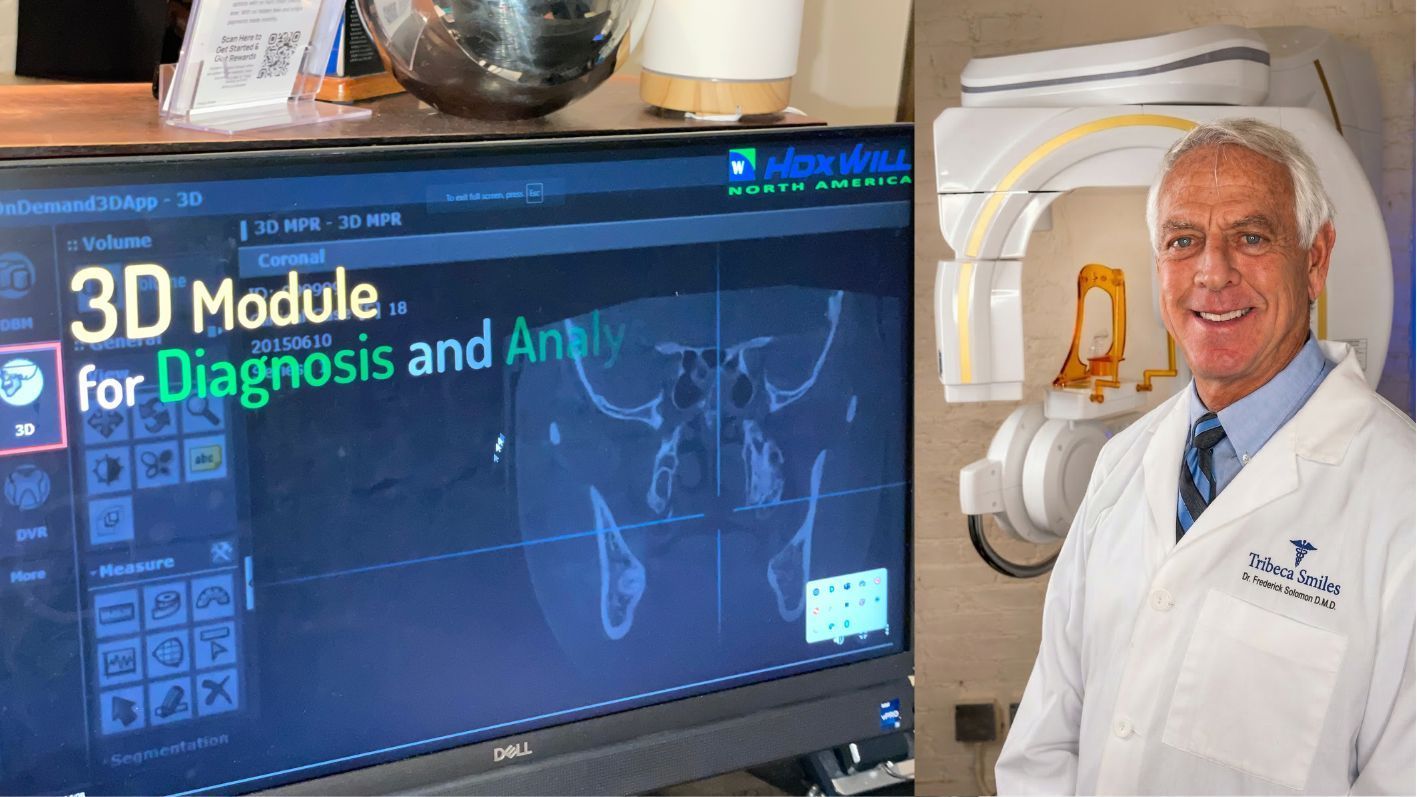
Cone Beam Computed Tomography (CBCT) provides the necessary data by using a rotating, cone-shaped X-ray beam to produce high-resolution 3D images of bone, nerves, and soft tissue.
Unlike traditional 2D X-rays that often feature overlapping structures or distortion, CBCT captures a complete volumetric dataset in under 40 seconds.
Technical Advantages of CBCT:
- 3D Visualization: It allows for viewing anatomy in axial, sagittal, and coronal planes with zero magnification error.
- Accuracy: Sub-millimeter resolution enables the 96% precision rate required for modern implant placement.
- Safety: It emits 6 to 15 times less radiation than a standard medical CT scan while offering superior dental detail.
- Clinical Utility: It identifies issues in the TMJ, airway, and root canals that traditional 2D imaging frequently misses.
At Tribeca Smiles, Dr. Solomon utilizes Dentri-Max 3D imaging to create a digital blueprint for every patient. This ensures that every restoration is grounded in your actual biological measurements.
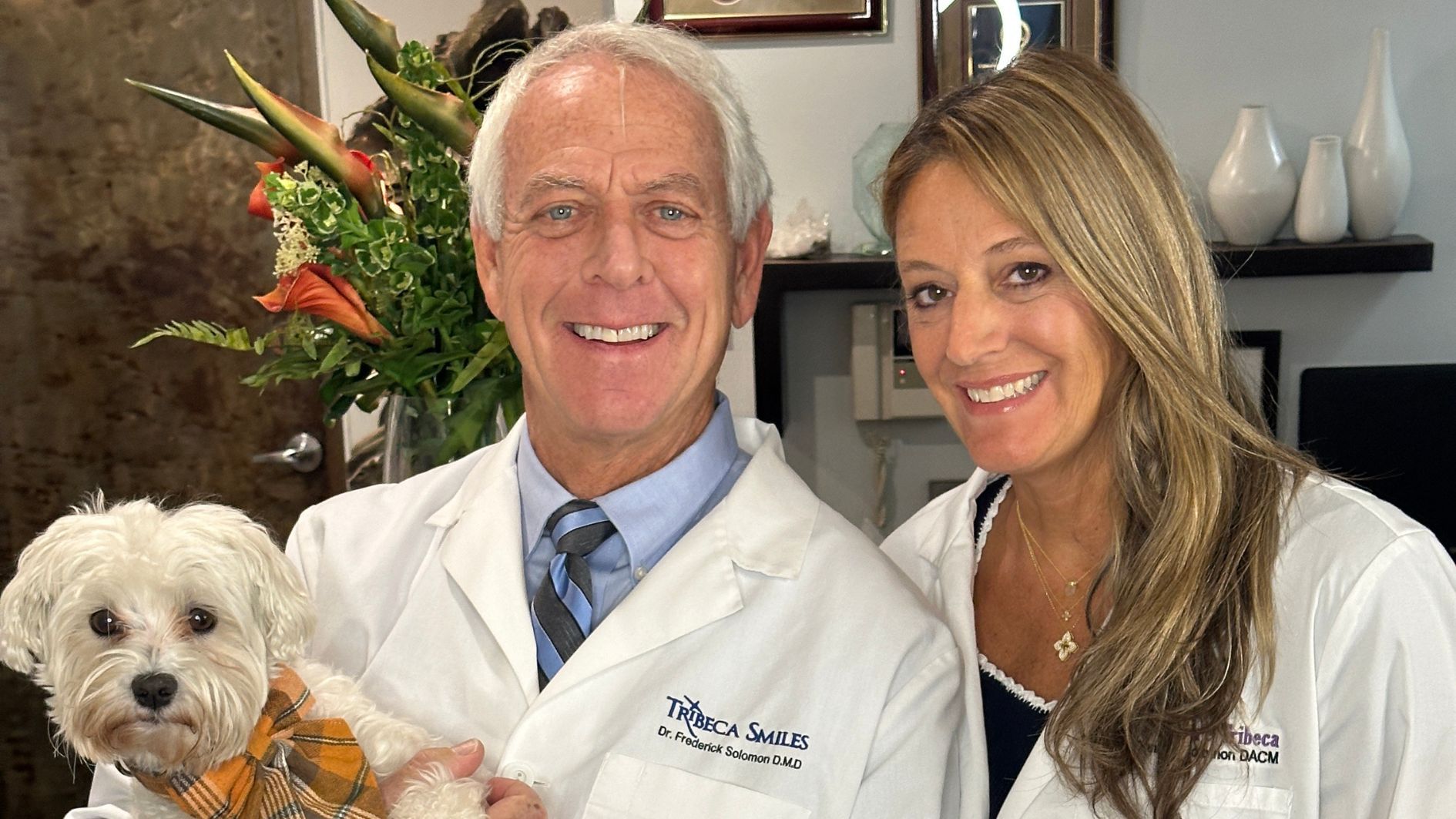
Meet Dr. Frederick Solomon: Cosmetic and Restorative Dentist in Tribeca
Dr. Frederick Solomon brings an unusual background to cosmetic dentistry—he started as a magician. That early interest in transformation now shows up in his approach to smile makeovers, combining technical precision with an eye for the dramatic reveal.
Dr. Solomon graduated from the University of Pennsylvania with a doctorate in dental medicine and completed a general practice residency at Albert Einstein Medical Center in Philadelphia.
His professional memberships include the American Academy of Cosmetic Dentistry, Academy of Esthetic Dentistry, and American Academy of Facial Aesthetics.
What sets Tribeca Smiles apart:
Dr. Solomon's practice integrates something most dental offices don't—collaboration with Dr. Danielle Solomon, a licensed acupuncturist.
Together they've developed an approach that uses Traditional Chinese Medicine techniques to address dental anxiety and promote relaxation during procedures.
The practice offers same-day emergency appointments, CEREC same-day crowns, Invisalign, and Dentri-Max 3D imaging for treatment planning. Currentspecials are available for new patients.
"Creating smiles that light up a room and inspire confidence—that's the magic of dentistry that I love." — Dr. Frederick Solomon
Schedule an appointment at Tribeca Smiles
Frequently Asked Questions
How much do these new cosmetic dentistry technologies cost compared to traditional treatments?
Costs vary by procedure, but many 2026 technologies reduce overall expenses by eliminating multiple appointments and lab fees. Same-day crowns, for example, often cost similarly to traditional crowns once you factor in the time and temporary restoration savings. Enamel regeneration gels typically cost less than veneer placement for early-stage cosmetic concerns.
Are enamel regeneration gels available at regular dental offices?
Availability is expanding throughout 2026. Not all practices have adopted the technology yet, so ask specifically whether your dentist offers protein-based remineralization treatments. The application process is similar to fluoride treatment—simple and non-invasive.
How long do bio-smart restorations last compared to traditional fillings?
Early data suggests bio-smart materials may outlast traditional composites because they actively prevent secondary decay at margins. However, these materials are relatively new, so 20-year longevity data doesn't exist yet. The theoretical advantage is significant based on how they protect the restoration interface.
Is AI smile design accurate? Will my results match the preview?
AI previews have become highly accurate in 2026, but they remain predictions. Factors like how your gums heal after contouring or subtle shade variations in final ceramics can create minor differences. Most patients find the final result very close to their preview, especially when working with experienced cosmetic dentists who know how to interpret and execute AI recommendations.
Do no-prep veneers work for everyone?
No-prep veneers work best for patients who want additive changes—adding length, closing gaps, or changing shape without dramatic size reduction. If your teeth are already protruding or you need significant color masking, minimal-prep or traditional veneers may produce better results. A consultation determines which approach fits your situation.
How does acupuncture help with dental anxiety during cosmetic procedures?
Acupuncture targets specific points that activate the parasympathetic nervous system, reducing the fight-or-flight response that causes anxiety. When combined with dental sedation options, patients often report feeling significantly calmer throughout longer cosmetic procedures like multiple veneer placements.